
Nonobjective
| Definition | Any composition devoid of intentional suggestion of any real world objects or cognitive mesages, but possibly containing geometric or patterned displays. Non-representation is equivalent to nonobjective. |
|---|---|
| Artist | Jackson Pollack |
| Title | Number One |
| Date | 1948 |
| Medium | Oil on Canvas |
| Location | MOCA, California |
| Source | World of Art - Kaitlyn Parrino (Online version) |
| Example | 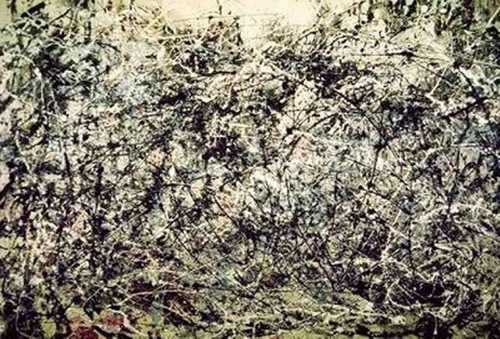 |
| Comments | Appears to simply be drip patterns and thrown paint landing in a chaotic order. In one regard this appears to be nonobjective. However, when I look at this painting I see anger, which is a cognitive message, so I am not sure where this leaves me. I also question where a nonobjective coposition is even possible. |
| Inspired |
Scanjak Ploclak was the most ungraceful knight in the land, and his name only amplified this, for no one could even pronounce it. He was as strong as an ox but he lacked grace and flair. Often his strokes and stabs would miss their mark or go wide. If not for his girth and size, surely he would have died long ago. He was often call Sir Ploc, or even worse Sir JakLak, which meant great laugh. This of course made him mad, and when he got mad he drank and boasted of skills he never had. After one such occassion, while riding across the land he heard a great roar, a dragon, as black as night, crossed is path. Normally knights and dragons tended to avoid one another, but this dragon recogned Sir Ploclak, and stopped to stare. Suddenly the dragon began to laugh why if it isn't Sir Jaklak, the most famous knight in the land. I think you will make a very tasty meal for me tonight!. Well something snapped and this was just one insult too many, the knight leap from his horse, and drew his sword, striding forward with great angry strokes, began attacking the dragon, who was completely surprised. Not a single stroke missed the mark, and when Scanjak finally stopped, the dragon was gone, only the land painted with dragon's blood remained. From that day forward he was called Sir Jak Polak, which meant great angry knight, and no one ever laughed again. |